Make your services understandable
Present your service focus, availability, coverage, and professional information before an enquiry relies on an assumed fit.
A professional account should make it easier to see whether a new property request belongs with your practice before it turns into an avoidable chase. With estateTT, valuators can present their services, control what they accept, and keep agreed work in one connected record.
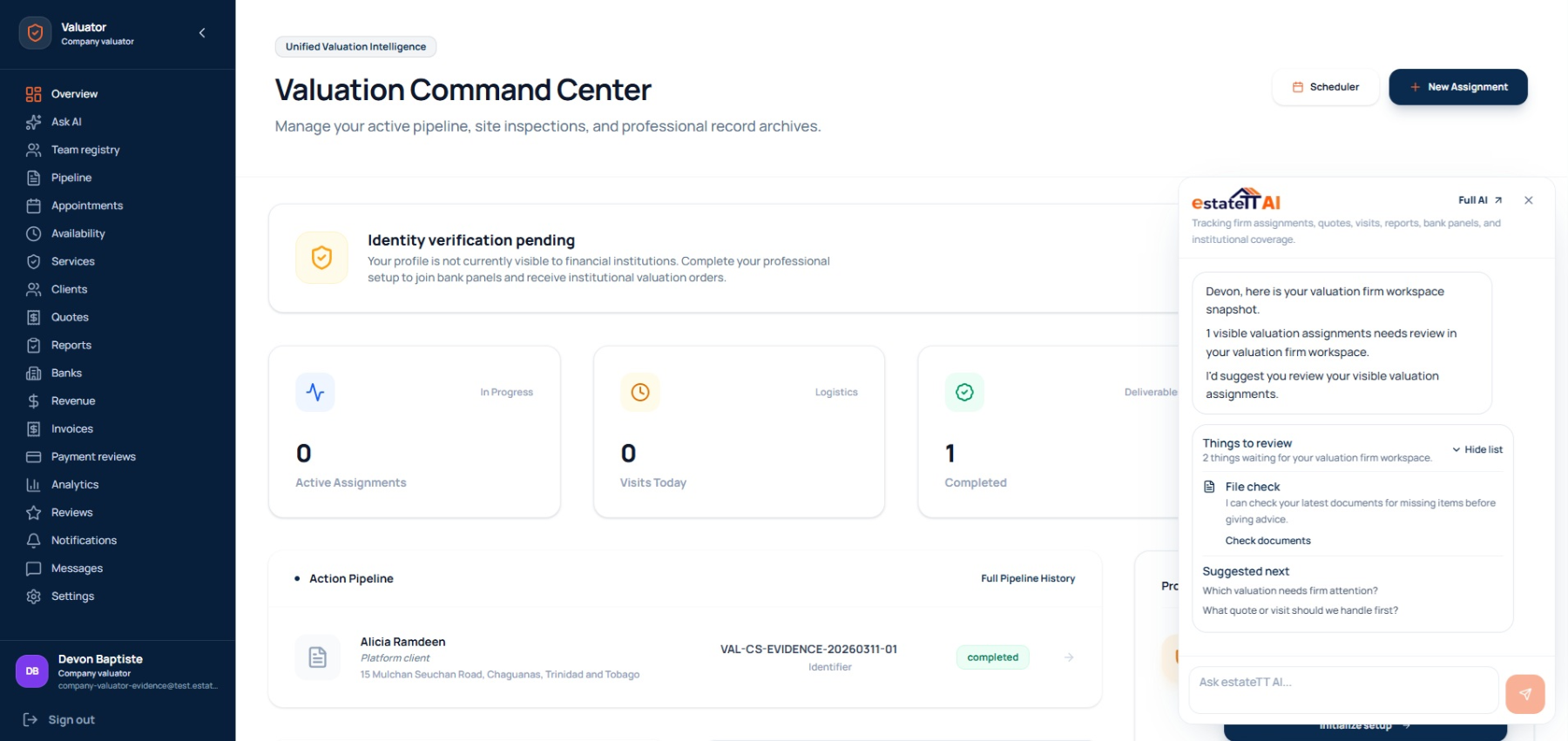
estateTT valuator account
Services, assignments, reports, and practice activity
Join
Choose the right account
Present services
Show what you provide
Review requests
Decide what fits
Deliver work
Manage the assignment
Build presence
Strengthen the practice
The commercial opportunity
The work remains particular to the property and instruction. The account improves the moment before that work begins: it gives an owner, agent, lender, or professional contact a more useful way to approach your practice.
Present your service focus, availability, coverage, and professional information before an enquiry relies on an assumed fit.
Review the purpose, property description, supplied material, access details, and conversation before you quote, clarify, or decline.
Once you accept work, retain its quote, appointment, report activity, client messages, invoice, and payment review in one operating record.
Property valuation CRM and practice management
Antigua and Barbuda valuation professionals can use estateTT to present their services and manage the operational side of accepted assignments in one clear account.
Keep requests, clients, quotes, inspections, reports, invoices, payment reviews, messages, reviews, and practice activity connected rather than relying on a patchwork of conversations.
The public signup route begins with an independent valuator. A firm can use pricing to assess the subscription path for team access and permission-aware operations.
Make it easier for the right client to understand your offering before making contact.
Review an enquiry and decide how to respond without allowing the request to define your terms.
Keep inspection, reporting, communication, invoicing, and payment review visible around work you accepted.
Use available reviews, analytics, and firm-team controls to see the operating side of the practice.
Where new demand becomes operational pressure
The difficulty is rarely only the inspection or report. It is qualifying a vague request, keeping the client informed, and retaining a usable record once the assignment has moved beyond the first conversation.
Without a stated purpose, property context, timing, access position, and client expectation, the practice must establish the basics before deciding whether to quote.
A document, instruction, location detail, and access change can arrive in different places. That fragmentation consumes attention before professional work has even begun.
Report questions, invoices, and follow-up are harder to manage when the agreed terms and prior communication are not visible together.
The subscribed-valuator path
01
Begin independently and establish the profile a prospective client will use to understand your work.
02
Show the service focus and availability that help an appropriate request reach you.
03
Consider the context provided before deciding to quote, seek clarification, or decline.
04
Keep appointments, reports, client communication, invoices, and payment review connected to the assignment.
05
Develop a stronger operating record while retaining full control of professional decisions.
Account-aware AI
Inside the account, estateTT AI can highlight missing context, open questions, and supported activity that needs attention. It supports the practice record without producing a property value, choosing a method, or replacing the valuator.
Draw attention to unanswered questions, missing information, or follow-up that still requires a professional response.
Help keep the operational status around quotes, appointments, reports, and client activity easier to see.
That assistance does not determine value, select methodology, assess evidence, set fees, approve reports, or make a lending or regulatory decision.
A useful partnership keeps the boundary clear
Why subscribe
Antigua and Barbuda’s Government includes a Land Registry Division and property valuation and tax-compliance functions. Those public functions are separate from estateTT, which provides participating valuators with a private operating workspace around the services they independently provide.
Let potential clients understand your services before the first request creates avoidable uncertainty.
Keep the quote, visit, report, invoice, payment review, and communication connected from the moment you take on an assignment.
The platform supports organization, while scope, methodology, evidence, fees, and valuation conclusions remain with the professional.
Choose with context
These routes show how estateTT participants may prepare property conversations before a professional is involved. They do not replace your own qualification of the client, instruction, or evidence.
Questions
Yes. It is a partner-acquisition page for professionals considering an estateTT subscription, not a page offering a valuation from estateTT.
No. It does not guarantee enquiries, assignments, revenue, panel placement, professional verification, or other commercial outcomes.
Yes. You decide whether an enquiry fits your services, capacity, commercial terms, and professional obligations. The platform does not accept work for you.
The public path starts with the individual_valuator account. A firm should use pricing to evaluate the subscription path for team access and permission-aware operations.
No. The platform does not determine property value, choose methodology, assess evidence, set fees, approve a report, or replace the valuator’s responsibilities.
Open the individual account when you are ready to present and run your own practice; review pricing first when the decision involves a valuation team.
An estateTT account helps organize property-workflow activity. It does not determine value, select methodology, set fees, accept work, approve panel participation, or replace the independent responsibilities of a valuator or another qualified professional.