Present your practice
Set out services, availability, coverage, and professional information before a client starts an enquiry.
Present your services, decide what work fits, and keep accepted assignments connected through quote, inspection, report, invoice, and payment review. With estateTT, the operating work stays connected while independent professional judgment stays with you.
estateTT valuator account
Services, assignments, reports, and practice activity
Join
Choose the right account
Present services
Show what you provide
Review requests
Decide what fits
Deliver work
Manage the assignment
Build presence
Strengthen the practice
The commercial opportunity
A serious instruction should show enough purpose, property information, access detail, and client history for the valuator to decide whether to engage. The platform organizes that context without resolving the professional questions.
Set out services, availability, coverage, and professional information before a client starts an enquiry.
Review the client’s stated purpose, property information, access position, supporting material, and conversation before deciding whether to quote, seek clarity, or decline.
Carry the appointment, reporting activity, client correspondence, invoice, and payment review with the accepted instruction.
Property valuation CRM and practice management
BVI valuation professionals can use estateTT for a direct profile and connected account around work they independently choose to accept.
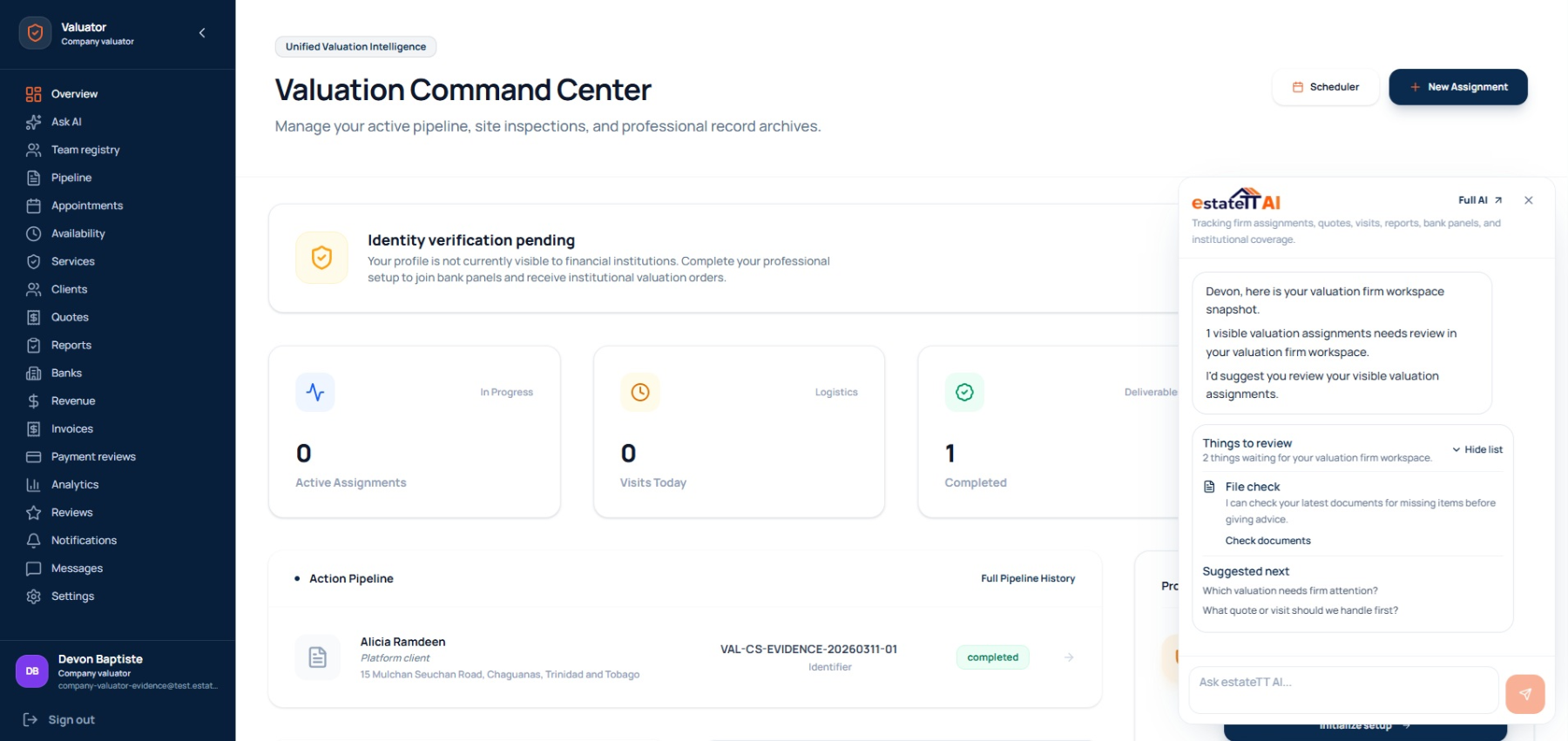
Keep requests, clients, quotes, visits, reports, invoices, payment reviews, messages, reviews, and practice activity together rather than rebuilding the assignment from separate threads.
Individual valuators use the public signup. A BVI firm should review pricing for the appropriate team-access and permission model.
Make it easier for an appropriate client to understand your service.
Review the available context and decide your professional response.
Carry site activity, reporting, client messages, invoices, and payment review in one assignment record.
Use supported reviews, analytics, and role-aware firm controls to monitor active practice work.
Where new demand becomes operational pressure
The platform cannot replace the valuator’s assessment. It can reduce the avoidable drag of vague requests, separated documentation, and no shared view of where an active assignment stands.
Purpose, timing, property context, and access may need to be established before the practice can decide whether to quote.
Documents, instructions, and report questions can appear in disconnected messages, making follow-up harder to manage.
A firm should be able to see the quote, visit, report, invoice, and next client action without relying on a single inbox.
The subscribed-valuator path
01
Start independently and build the professional profile a prospective client can assess.
02
Clarify your availability and service focus before enquiries arrive.
03
Use the supplied context to quote, clarify, or decline.
04
Keep appointments, reporting, messages, invoices, and payment review joined to accepted work.
05
Strengthen the operating record while retaining full professional judgment.
Account-aware AI
Built into the workspace, estateTT AI can surface missing context, open follow-up, and supported account activity. It supports the working record without determining property value, selecting methodology, or assessing evidence.
Highlight unanswered request detail and follow-up that still need a professional response.
Review current requests, quoted work, scheduled visits, reporting, and client activity together.
That support cannot form a value opinion, set the fee, approve reporting, or decide a legal, tax, or lending matter.
A useful partnership keeps the boundary clear
Why subscribe
The British Virgin Islands Land and Survey Department maintains public land-registration, mapping, and survey information. That public function is separate from estateTT, which gives participating valuators a private workspace for independent professional services.
Help clients describe what they need before the practice commits time to an unclear instruction.
Keep the instruction, quote, visit, report, invoice, payment review, and client exchanges visible in one professional record.
The platform holds the operating activity; the valuator retains responsibility for scope, evidence, methods, fees, and conclusions.
Choose with context
These routes show how property activity can become a better-prepared professional conversation. They do not replace your own qualification of the client, instruction, or evidence.
Explore the broader estateTT account and its separation from valuation judgment.
Assess the individual account against the BVI firm option for team permissions and oversight.
See how BVI agent records can retain useful context before a professional valuation request begins.
Questions
Yes. The intended reader is an independent BVI valuator or firm deciding whether an estateTT partner plan fits.
No. The platform does not promise enquiry volume, accepted instructions, panel participation, earnings, verification, or another result.
Yes. Your practice decides which enquiries suit its services, workload, terms, and professional obligations.
The public signup is for individual valuators. A firm should assess pricing for its team-access and permission needs.
No. It does not determine value, select methodology, assess evidence, set fees, approve reports, or replace the valuator’s independent role.
Open the individual workspace to make the practice easier to approach and run. When the decision is for a BVI firm, compare the team plan before subscribing.
An estateTT account helps organize property-workflow activity. It does not determine value, select methodology, set fees, accept work, approve panel participation, or replace the independent responsibilities of a valuator or another qualified professional.