Present your practice
Show services, availability, coverage, and professional information before a client starts an enquiry.
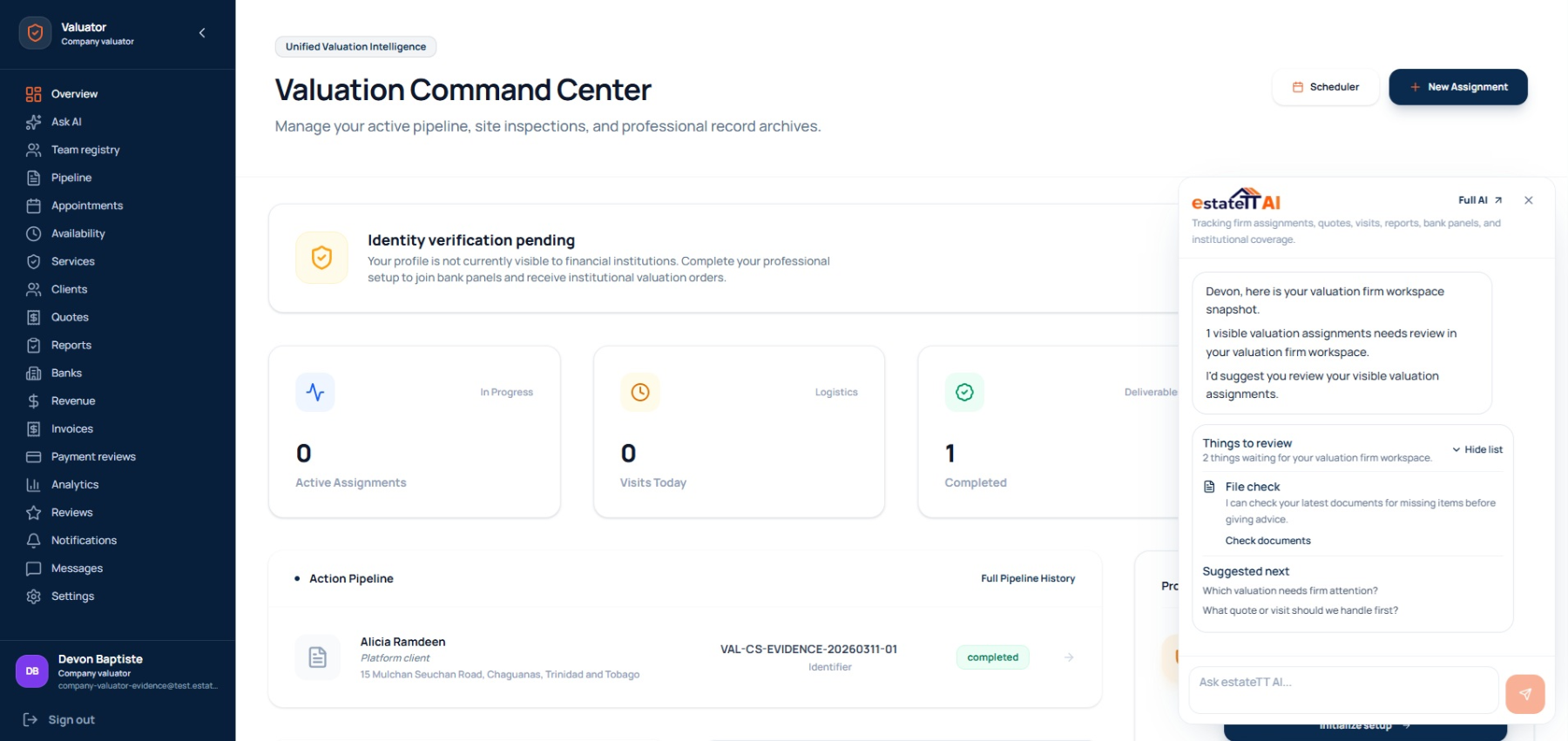
Present services clearly, choose the requests that fit, and keep accepted assignments connected through quote, inspection, report, invoice, and payment review. With estateTT, the operating work stays connected while the independent valuation remains yours.
estateTT valuator account
Services, assignments, reports, and practice activity
Join
Choose the right account
Present services
Show what you provide
Review requests
Decide what fits
Deliver work
Manage the assignment
Build presence
Strengthen the practice
The commercial opportunity
The platform does not make the valuation. It gives a Cayman practice a more useful way to see the purpose, property context, documents, access detail, and communication around a request before deciding whether to engage.
Show services, availability, coverage, and professional information before a client starts an enquiry.
See purpose, property detail, supplied material, access information, and messages together before quoting, clarifying, or declining.
Retain the appointment, report, client communication, invoice, and payment review around work you accept.
Property valuation CRM and practice management
Cayman valuation professionals can use estateTT for a direct profile and connected account around the services and assignments they choose to provide.
Keep requests, clients, quotes, appointments, reports, invoices, payment reviews, messages, reviews, and practice activity in one record rather than split across separate conversations.
The public path begins with the independent valuator account. A firm can compare pricing to evaluate team access and permission-aware operations.
Make it easier for the right client to understand your practice before contact.
Review context and decide your response on professional terms.
Keep visits, reports, messages, invoices, and payment review connected.
Use available reviews, analytics, and firm-team controls around your practice.
Where new demand becomes operational pressure
A serious instruction can still arrive as several disconnected messages. The operating burden appears when the practice must reconstruct the request, client trail, and delivery position before it can give a clear answer.
Purpose, timing, access, and property context may be missing when the practice first hears from the client.
Documents, location information, appointment changes, and report questions can arrive in different threads.
A firm needs a shared record of the quote, visit, report, invoice, and next client action.
The subscribed-valuator path
01
Begin independently and establish the profile prospective clients use to assess your service.
02
Clarify availability and service focus before enquiries arrive.
03
Quote, clarify, or decline based on the context supplied.
04
Keep the appointment, reporting status, correspondence, invoice, and payment review tied to the instruction.
05
Strengthen the operational record without transferring professional judgment.
Account-aware AI
Inside the account, estateTT AI can surface missing context, open follow-up, and supported account activity. It helps organize the practice record without determining value, selecting methodology, assessing evidence, or replacing the valuator.
Highlight request gaps and follow-up that still need a professional response.
Keep open requests, quote decisions, appointments, reports, and client actions visible.
That support does not determine property value, set fees, approve reports, or make legal, lending, or governmental decisions.
A useful partnership keeps the boundary clear
Why subscribe
Cayman Islands Lands and Survey provides public land-registration, survey, geographic, and valuation services. Those public functions are separate from estateTT, which gives participating valuators a private workspace for independent professional services.
Give a prospective client a better way to frame the purpose and property context before the practice spends time on a response.
Keep the instruction, quote, appointment, report, invoice, payment status, and client exchanges tied to the work.
The platform keeps operational activity orderly while the valuator owns scope, evidence, methodology, fees, and conclusions.
Choose with context
These routes show where platform activity can lead to better-prepared professional conversations. They do not replace your own qualification of a client, instruction, or evidence.
Examine the complete valuator workspace and the responsibilities estateTT leaves with the professional.
Compare the independent workspace with the Cayman firm route for team access and oversight.
See how Cayman agents can preserve client and property context before involving a valuator.
Questions
Yes. It is for Cayman valuators and practices assessing estateTT as a subscribed professional workspace.
No. A subscription does not guarantee requests, assignments, panel status, professional verification, revenue, or commercial performance.
Yes. You decide which requests fit your services, capacity, commercial terms, and responsibilities.
The public signup begins with individual_valuator. A firm should use pricing to assess team access and permission-aware plans.
No. It does not determine value, choose a method, assess evidence, set fees, approve reports, or replace the valuator’s independent role.
Use the individual account to make your availability, service offer, and accepted work easier to manage. For a practice with a team, assess firm pricing before subscribing.
An estateTT account helps organize property-workflow activity. It does not determine value, select methodology, set fees, accept work, approve panel participation, or replace the independent responsibilities of a valuator or another qualified professional.