Present the work you are prepared to do
Set out your services, service areas, availability, and professional profile so a potential client or connected platform participant has a credible basis for approaching you.
A serious instruction should not become a hunt for the basics before you can decide whether it belongs with your practice. Through estateTT, participating valuators gain a clearer professional front door and a connected workspace for the work they choose to take on.
estateTT valuator account
Services, assignments, reports, and practice activity
Join
Choose the right account
Present services
Show what you provide
Review requests
Decide what fits
Deliver work
Manage the assignment
Build presence
Strengthen the practice
The commercial opportunity
In Guyana, the practical property context can matter as much as the client’s first description. A good starting point lets the valuator see enough to decide whether the instruction is relevant, without pretending that the platform has already answered the professional questions.
Set out your services, service areas, availability, and professional profile so a potential client or connected platform participant has a credible basis for approaching you.
Review the stated purpose, property context, materials, access position, and communication trail together before you quote, request more information, or decline.
Once you accept work, retain its quote, inspection planning, report progress, client messages, invoicing, and payment review in the same operating record.
Property valuation CRM and practice management
Guyana valuators can use estateTT for a more useful professional presence than a single contact point. It connects the services you choose to offer with the operational record around requests you choose to accept.
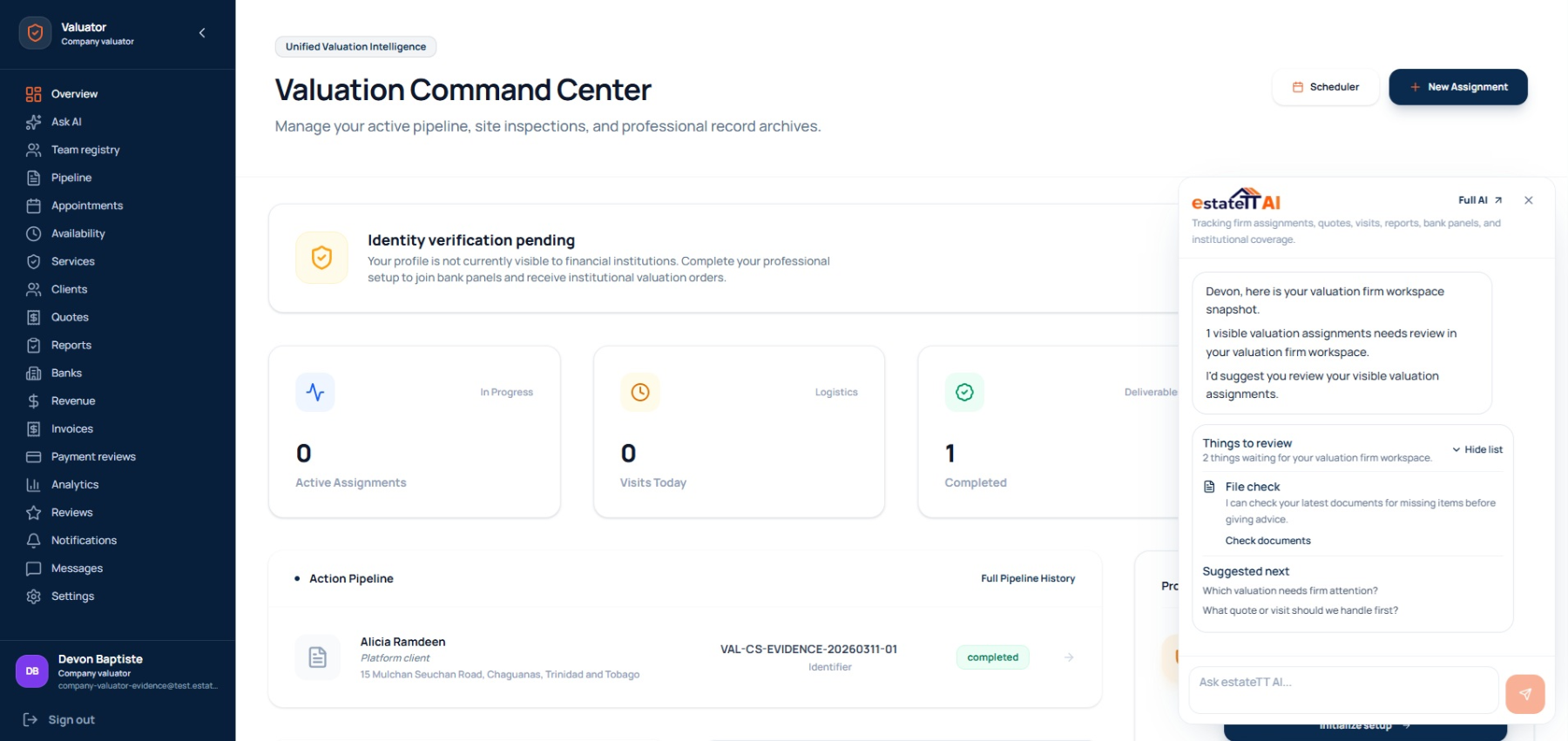
Use the account to keep clients, quotes, appointments, reports, invoices, payment reviews, messages, reviews, and practice activity together. The platform can support a more orderly practice; your assessment, scope, fee, evidence, and conclusion stay with you.
The public path is for an independent valuator. A valuation firm can review the plan that supports team access and permission-aware practice operations before subscribing.
Make it clearer what your practice does and when an enquiry is worth bringing to you.
Consider incoming context, respond on your terms, and retain the commercial thread with the work.
Keep inspections, report progress, clients, invoices, payment reviews, and communication attached to the accepted assignment.
Use available reviews, analytics, and firm-team controls to manage the practice with better visibility.
Where new demand becomes operational pressure
A valuator can make a sound professional decision only after the relevant facts are established. The operational drag comes when the initial enquiry fails to distinguish what is known, what is missing, and who needs to provide it.
Guyana’s Lands and Surveys Commission distinguishes public-land administration from other land interests. An instruction that leaves the property’s practical position unclear can need more qualification before it is ready to scope.
A client may send a plan, contact, location clue, or document through separate channels. The time cost grows when those pieces cannot be reviewed as one request.
After the inspection, report questions, invoice status, and client follow-up should not depend on a private recollection of what was agreed weeks earlier.
The subscribed-valuator path
01
Begin independently and set up the professional presence prospective clients will use to assess your services.
02
Clarify your availability and service focus before a property conversation turns into an instruction.
03
Look at the context provided, then decide whether to quote, ask for more detail, or decline.
04
Keep appointments, report status, client messages, invoices, and payment review connected to the work.
05
Build a more reliable professional operating record without outsourcing any valuation decision.
Account-aware AI
Working from supported account activity, estateTT AI can surface missing context and open follow-up around a request or assignment. It helps a Guyana valuator manage the working record; it does not investigate land, assess evidence, or produce a valuation conclusion.
Bring attention to unanswered request details, client follow-up, or activity that has not yet been completed.
Support a clearer view of active requests, quotes, appointments, reports, and related client activity.
That support does not determine value, select methodology, set fees, approve evidence, or make a financing or regulatory decision.
A useful partnership keeps the boundary clear
Why subscribe
The Guyana Lands and Surveys Commission administers public lands and related land-survey and valuation functions. That public role is separate from estateTT, which gives participating valuators a private workspace around the services they independently provide.
Help the right prospective client explain what they need before your practice invests time in the conversation.
Retain the request, quote, visit, report, invoice, payment review, and communication around work you accepted.
The platform can organize the practice without determining the property value, instruction scope, methodology, evidence, fee, or conclusion.
Choose with context
These routes show where property interest can become a professional conversation. They do not remove the valuator’s own responsibility to qualify the client, property, and instruction.
See how the wider valuator account supports professional work while keeping valuation decisions outside estateTT.
Review the solo account against the team-plan route for a Guyana valuation firm.
See how agent activity can be organized before an enquiry comes to a valuator.
Questions
Yes. It is for independent valuators and valuation firms considering an estateTT subscription, not for a client seeking a valuation conclusion from estateTT.
No. The platform does not guarantee enquiries, assignments, revenue, professional verification, panel placement, or another commercial outcome.
Yes. You decide whether a request fits your services, capacity, fees, and professional obligations. The platform does not accept instructions for you.
The public signup flow begins with the individual_valuator account. A valuation firm should use pricing to assess the team and permission-aware plan path.
No. The platform does not determine value, choose a method, assess evidence, set fees, approve reports, or replace the valuator’s independent responsibilities.
Start independently to present your services and manage the work you choose to accept. For a firm setup, compare the plan before subscribing.
An estateTT account helps organize property-workflow activity. It does not determine value, select methodology, set fees, accept work, approve panel participation, or replace the independent responsibilities of a valuator or another qualified professional.