Make your services easier to understand
Set out the valuation services you provide, the areas you cover, your availability, and the professional profile users should review before deciding whether to approach you.
Subscribe as an independent valuator or valuation firm, present the services you provide, and give estateTT users a professional route into your practice. Your account keeps requests, quotes, inspections, reports, clients, and commercial activity connected while every valuation conclusion remains yours.
estateTT valuator account
Services, assignments, reports, and practice activity
Join
Choose the right account
Present services
Show what you provide
Review requests
Decide what fits
Deliver work
Manage the assignment
Build presence
Strengthen the practice
The commercial opportunity
Buyers, sellers, agents, brokers, and lenders can reach points where independent valuation work is needed. A subscribed valuator account gives those requests a defined route into your practice without taking control of your acceptance, scope, fee, or conclusion.
Set out the valuation services you provide, the areas you cover, your availability, and the professional profile users should review before deciding whether to approach you.
Review the client, property, purpose, available documents, proposed timing, and open questions before deciding whether to quote, decline, or request more information.
Carry accepted work through quoting, scheduling, inspection activity, report delivery, invoicing, payment review, and client communication without reconstructing the file from separate channels.
Property valuation CRM and practice management
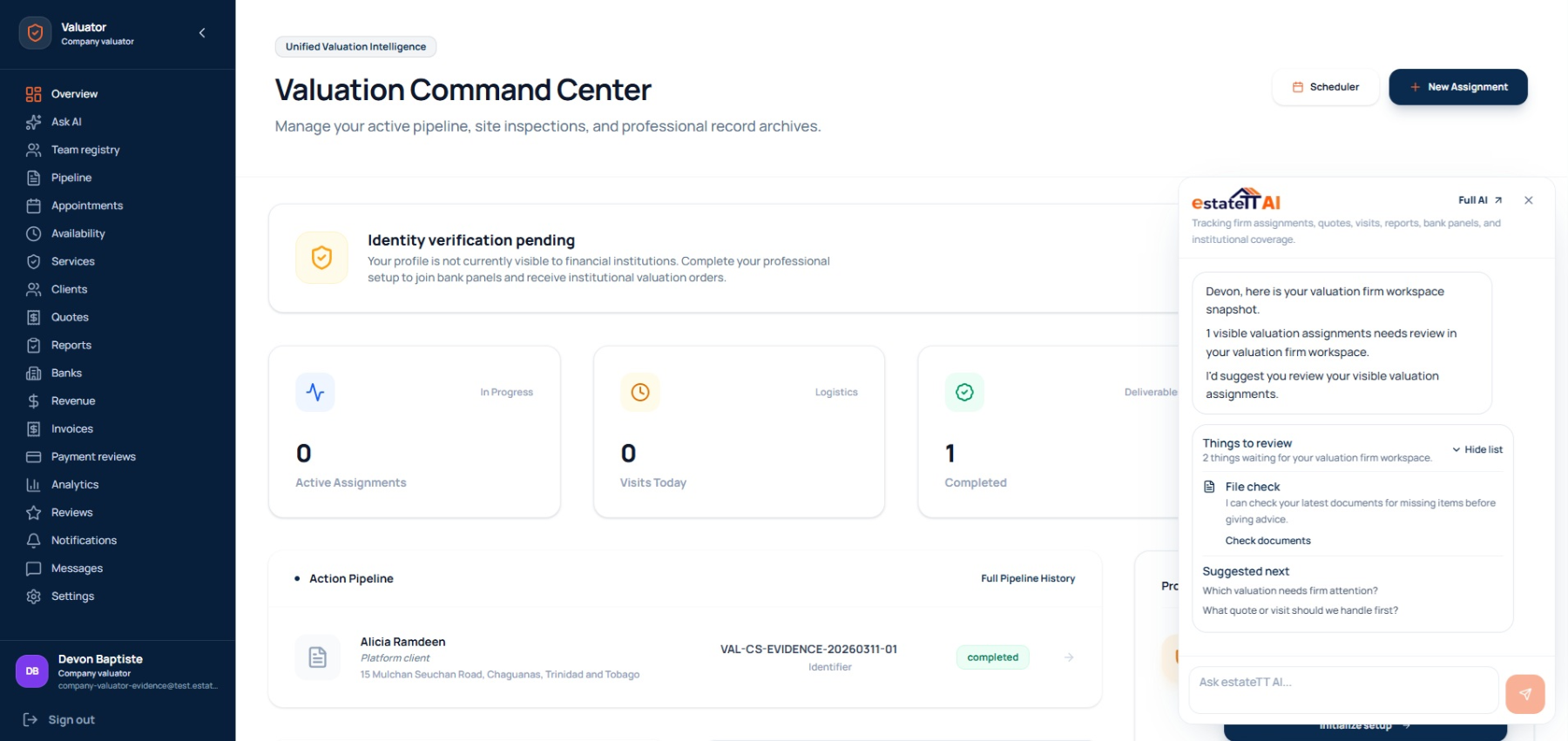
The valuator account is both a professional presence and an operating workspace. It connects your services, availability, requests, quotes, site visits, reports, clients, invoices, payment reviews, revenue records, reviews, messages, and notifications.
Independent valuators can manage their own pipeline. Valuation firms can add team structure and permission-aware oversight so responsibility and sensitive commercial views remain appropriate to each member's role.
Plan entitlements determine the exact tools available. The reason to subscribe is not a vague promise of exposure; it is a defined route for receiving suitable interest and running the resulting professional work with continuity.
Give platform users a clearer view of the services, coverage, availability, and professional profile attached to your practice.
Review requests, ask for missing context, provide a quote, or decline before the work enters your active valuation pipeline.
Keep inspections, reports, invoices, payment reviews, messages, and client activity tied to the professional work they concern.
Use a solo professional account or a team workspace with role-aware access, firm oversight, analytics, and service administration where the selected plan supports them.
Where new demand becomes operational pressure
A new source of professional interest can become another inbox to monitor unless the service offer, acceptance decision, work record, and commercial follow-through stay connected.
The request still needs professional review. Preserve the difference between an interested platform user and work you have accepted on a scope and fee you control.
A public profile may attract attention, but delivery depends on capacity, availability, quote decisions, inspection coordination, evidence, reporting, and payment follow-through.
When several valuators work through one firm, team access and oversight should reflect each person's role instead of exposing every setting and commercial view to everyone.
The subscribed-valuator path
01
Choose the independent professional or valuation-firm path that matches how your practice operates.
02
Complete the professional setup and define the services, coverage, availability, and profile users should review.
03
Assess incoming interest, request more context where needed, and decide what should become a quoted assignment.
04
Coordinate the inspection, report, client communication, invoice, and payment review around the accepted assignment.
05
Use completed work, reviews, service administration, panel activity, and practice records to support a stronger platform presence over time.
Account-aware AI
Built into the workspace, estateTT AI can review supported activity and bring open assignments, quotes, visits, reports, invoices, services, reviews, notifications, panel activity, or subscription context back into view. It remains advisory and does not perform valuation work.
Use account-aware prompts to return to unread requests, active assignments, quote pressure, scheduled visits, report drafting, invoices, or other supported work that may need action.
An independent valuator can review a personal queue. Authorized firm members can use permission-aware signals across team workload, services, panels, revenue, analytics, or administration where access permits.
That account-aware support does not inspect property, choose methodology, verify evidence, estimate market value, approve lending, set fees, or replace professional and regulatory obligations.
A useful partnership keeps the boundary clear
Why subscribe
This page is for valuators considering estateTT as a channel and operating workspace for their own professional services. It does not promise assignments or place estateTT inside the valuation judgment.
Let suitable users approach your practice while you retain control over acceptance, scope, timing, and fees.
Keep the assignment, quote, inspection, report, invoice, payment review, and client communication connected.
Use the workspace to run real service activity rather than paying only for a passive directory listing.
Choose with context
Use the broader role page, pricing, and public valuation route to understand the workspace, the subscription choices, and how platform users encounter participating valuators.
Review the broader valuator proposition and the professional account estateTT provides.
Compare current independent and firm subscription choices, seats, features, and commercial terms.
See the user-facing route through which participating valuators and their services can be discovered.
Questions
It is for independent valuators and valuation firms considering a subscribed estateTT provider account. People seeking valuation services use the platform's valuation and property workflows to find and approach participating professionals.
Use the independent path when you operate your own professional queue. A firm plan is intended for practices that need team membership, role-aware access, shared oversight, and firm-level administration. Compare the current plans before subscribing because exact entitlements vary.
No. A subscription provides the professional workspace and a route for suitable platform users to approach your practice. It does not guarantee request volume, assignment acceptance, panel placement, revenue, or a particular commercial outcome.
Supported areas include services, availability, assignments, quotes, inspections, clients, reports, bank-panel activity, revenue, invoices, payment reviews, analytics, reviews, notifications, messages, settings, and team administration for authorized firm accounts. Access depends on role and plan entitlements.
No. You retain responsibility for scope, evidence, inspection, methodology, fees, professional obligations, and the final report. The account organizes the commercial and operational activity around the assignment.
Create an independent valuator account or compare the available professional and firm plans before choosing the workspace that fits how you operate.
An estateTT subscription provides a workspace and a route between platform users and participating valuation professionals. It does not guarantee assignments, certify credentials, inspect property, determine value, approve lending, or replace the valuator's independent checks, methodology, professional duties, fees, conclusions, and responsibility for service delivery.