Make the first approach useful
Set out services, availability, practice information, and request expectations so a prospective client has a purposeful way to start.
Give clients a better way to find the practice and explain what they need. Then decide what fits, quote with the right context, and manage accepted work through appointment, documents, session activity, payment review, and practice oversight.
estateTT notary account
Requests, quotes, appointments, documents, and sessions
Join
Choose the right account
Set services
Define what you provide
Review requests
Decide what fits
Quote and schedule
Protect your calendar
Manage matters
Keep accepted work connected
The professional opportunity
The account turns a first enquiry into a deliberate choice for the practice, then keeps the accepted matter connected as the work develops.
Set out services, availability, practice information, and request expectations so a prospective client has a purposeful way to start.
Review the service needed, people involved, property context, timing, documents, and messages before deciding whether to clarify, quote, or decline.
Keep the client, quote, appointment, documents, messages, session activity, payment review, and follow-up together once you accept the matter.
Notary CRM and practice management
A Bermuda notary account gives the practice a place to turn professional visibility into a managed client route.
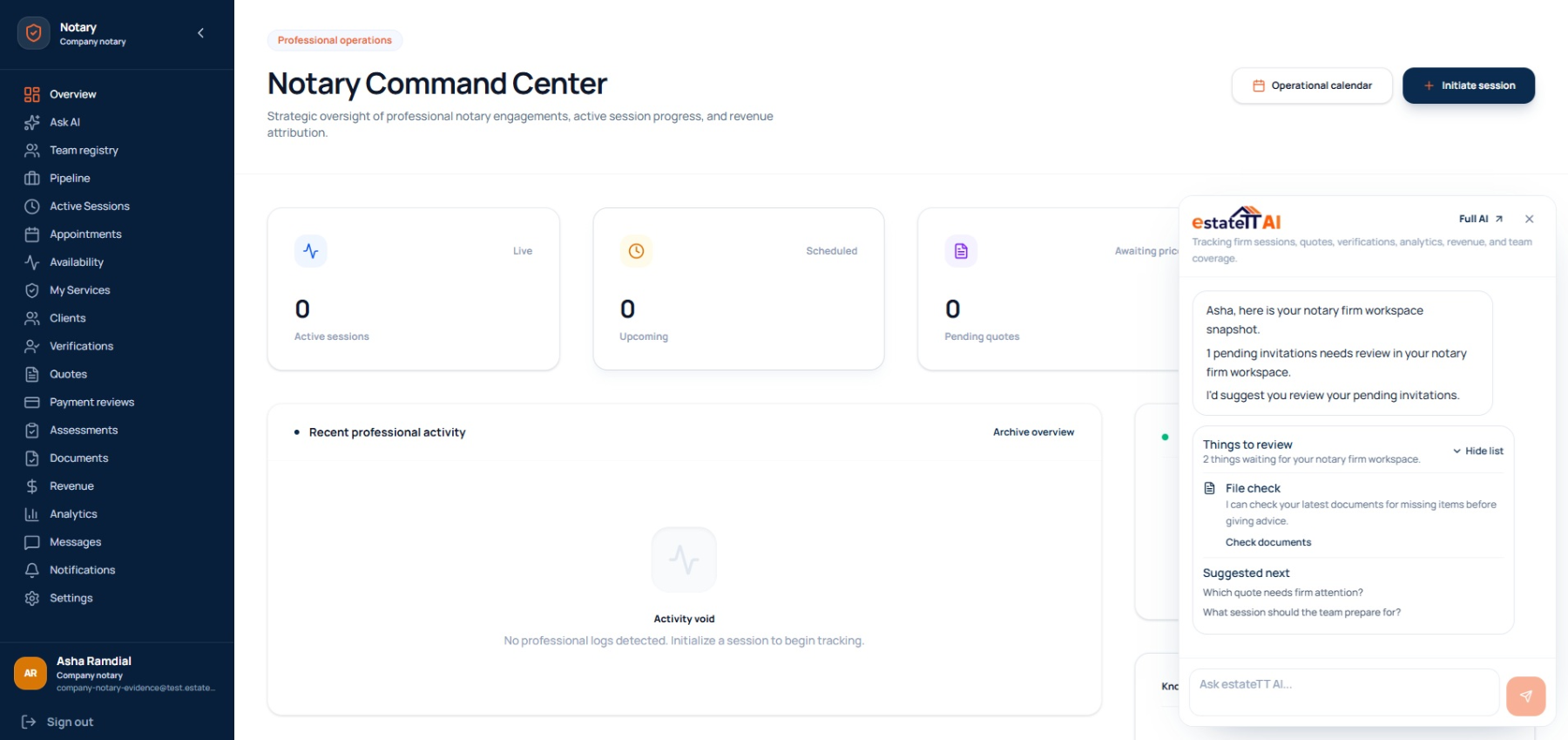
Bring together leads, services, clients, availability, quotes, appointments, documents, verification activity, sessions, messages, payment reviews, revenue, and account analytics.
Begin as an individual notary or choose a firm plan when the practice needs permission-aware team operations.
Help a prospective client understand the practice, its services, and how to make a request worth reviewing.
Assess the relevant context before the practice commits time to a quotation or appointment.
Keep selected work connected from the first conversation through payment review instead of reconstructing the story from scattered threads.
Use account activity, payment review, revenue, and analytics to understand what the practice is carrying and where attention may be needed.
Where a new request becomes operational pressure
The problem is not simply a busy calendar. It is time spent decoding vague messages, repeating the same qualifying questions, and losing the thread between a promising enquiry and the work the practice eventually accepts.
A client does not know what information matters, so the practice has to rebuild basic context before it can decide whether the request belongs there.
A suitable request may reach a quote, yet appointments, documents, messages, and payment follow-up drift into separate places.
Without a connected account view, the urgent-looking conversation can take precedence over the matter that has actually been waiting longest.
The subscribed-notary path
01
Choose the individual or firm account that fits how the professional practice operates.
02
Define services, availability, practice information, and the expectations for a useful request.
03
Assess the people, property context, documents, timing, and messages before deciding whether to proceed.
04
Turn suitable work into a clear quote and appointment without leaving the original context behind.
05
Keep accepted work connected through documents, sessions, messages, payment review, and practice activity.
Account-aware AI
estateTT AI can surface incomplete requests, stale follow-up, open context, and account activity that may need attention. It does not provide legal advice or make professional decisions.
Bring incomplete requests and unanswered client activity back into view without deciding whether the practice should accept the work.
Use the attached client, property, document, quote, and message context before you reply, clarify, or prepare a quote.
estateTT AI does not enrol, certify, advise, conduct title work, or decide whether a notarial act should proceed.
A useful partnership keeps the boundary clear
Why subscribe
Bermuda’s Commissioners for Oaths and Notaries Public Act 1972 places enrolment of notaries with the Supreme Court and requires the Registrar to keep the roll. estateTT does not replace that authority; it gives the practice a better commercial route for the work clients bring to it.
Give prospective clients a proper route into the practice instead of asking them to guess what information matters.
Decide what fits before you quote or schedule, then keep the accepted matter connected around the work.
See the relationship between services, requests, accepted matters, payments, revenue, and account activity.
Choose with context
Review the professional account and the property context that can bring clients toward the practice.
See the role, account tools, and subscription options available to notaries.
Compare the available subscription plans before you establish the practice account.
See the buying journey that can create a need for professional property support.
Questions
It provides a place to present services, receive and review requests, manage clients, quotes, appointments, documents, sessions, messages, payment review, revenue, and account activity.
No. Under the Commissioners for Oaths and Notaries Public Act 1972, the Supreme Court may enrol notaries and the Registrar keeps the roll. estateTT does not enrol, list, or authorize notaries.
No. A subscription provides the professional account and tools described on this page. The notary decides what to accept, and client demand and commercial outcomes are not guaranteed.
Yes. You control the services you present and retain professional judgment over whether to clarify, quote, schedule, or decline a request.
Yes. The platform supports individual accounts and firm plans, with the available team controls depending on the selected plan.
Start the account to present your services, control what you accept, and keep selected work connected from first enquiry through follow-up.
An estateTT subscription provides professional-presence and practice-management tools. It does not enrol, list, or verify a Bermuda notary; certify documents; provide legal advice; conduct title work; hold client funds; or replace professional responsibilities under Bermuda law.